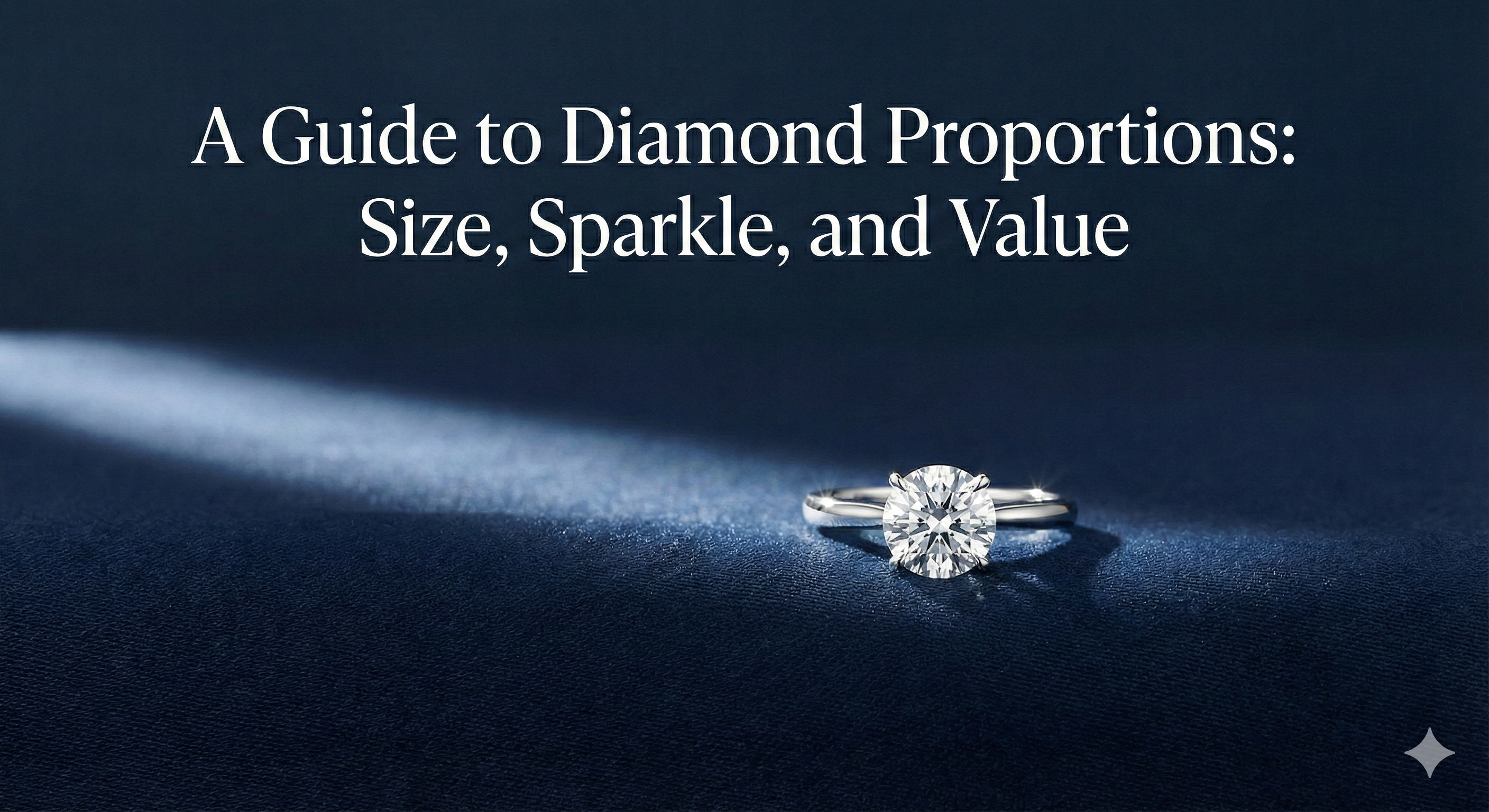
A Guide to Diamond Proportions: Size, Sparkle, and Value
A diamond's carat weight tells you how much it weighs, but it doesn't tell you how large it looks or how brilliantly it sparkles. The secret to a diamond's visual impact lies in its proportions—the precise relationship between its size, depth, and angles. Understanding this balance is key to finding a diamond that truly wows.
At M&B, we work with every client and every preference, regardless of your unique taste. Because we do not present consignment goods in our shop, every diamond you see on display has passed our rigorous quality control – they’re hand-selected to meet our high standards. While our inventory is carefully curated, we actively source diamonds globally and are deeply connected within the diamond industry. If a client requests a specific item not currently in stock – whether it’s a particular carat weight, color, clarity, or shape – our extensive network and expertise in buying, selling, and cutting rough diamonds allow us to quickly find a diamond that meets our standards and offers excellent value.
Our expertise is focused on providing diamond of quality, which often relies in finding well-priced diamonds that pass our QC in clarity and color. Beyond that one of high priority is maximising face-up coverage to ensure your diamond possesses a commanding presence without ever compromising its brilliance.
What are diamond proportions?
Proportions refer to a diamond's measurements and how they relate to one another. This includes its table size (the large, flat facet on top), its depth, and the angles of its facets. These elements work together to control how light enters, reflects within, and exits the stone.
When a diamond is super well cut, light is maximized, creating the dazzling brilliance and fire that diamonds are famous for. A poor cut, however, can make even the most expensive diamond appear dull and lifeless.
The balancing act: Depth and Ratio
When it comes to selecting a diamond, there is no single "right" answer.
Beauty is subjective. What captures one person's heart might not appeal to another. Some people love the elegant elongation of a long emerald cut, while others prefer a squarer, more compact look. Ultimately, the perfect diamond is the one that speaks to you.
The depth of a diamond refers to the distance from the table (the flat top facet) to the culet (the bottom point). The ratio, on the other hand, is the relationship between the diamond's length and width. Together, these factors determine how light interacts with the diamond and how much of its weight is visible from the top.
Our preference tends to balance ratio and depth to ensure you get the most impressive look for your budget. We focus on "face-up coverage"—a term gaining traction with industry experts because it describes the actual surface area the diamond covers on your finger, rather than just its weight on a scale.
If you are investing $15,000 in a diamond, you deserve to see that value on your hand.
- The M&B ideal: While some clients prefer elongated emerald cuts around a 1.45 ratio and others prefer a shorter 1.35 ratio, our focus remains on maximizing the diamond's visual size. In either case, an M&B diamond must have a depth under 66% to ensure it offers the largest possible millimeter size for its weight.
Drop the pear , but say while some prefer elongated 1.45 ratio emerlads and some prefer shorter ratio of 1.35 , in both cases an mnb diamond will have to be under 66% depth to maximise it’s mm size
None of these are incorrect. But our curation strategy works to maximize that coverage area while ensuring the diamond doesn't become "flat." A diamond that is too flat might look huge, but it will lose its luster and look lifeless. We find the golden mean: maximum size, maximum sparkle.
To achieve this, Roi, our co-founder developed the M&B 1-10 scale, which helps assess what a certificate can't show: how a diamond truly performs.
- A diamond scoring 1/10 might have a good carat weight but is cut too deep or too shallow. This causes light to escape, creating dark spots or a glassy, "fisheye" effect, and it will look smaller than its weight suggests.
- A diamond scoring 9/10 or 10/10 is a masterclass in diamond cutting. Its proportions are perfectly balanced to maximize both its visual size and its sparkle. This is where you find incredible value.
Why face-up coverage matters
Face-up coverage, or the diamond's visual size, is crucial because it determines how large your diamond appears. Two diamonds with the same carat weight can look drastically different in size depending on their cut. This is where your investment truly shows.
Ideal proportions are unique to each diamond shape. An emerald cut, for instance, has different ideal ratios than a pear shape diamond. To maximize visual impact, each shape must be cut to its own specific standards.
We have developed specialized criteria to assess every shape we carry. This ensures that whichever shape you choose—from an elegant marquise to a radiant cut—you receive a diamond that offers the maximum possible face-up coverage. We want your investment to look as impressive as it deserves to be.
Expert selection: why we invest in our inventory
Unlike many online retailers, We do not present consignment goods in our shops . We do not list diamonds that belong to other suppliers. We come from the world of diamond manufacturing, and we invest our own capital into our inventory.
This distinction is critical for you as a buyer.
Because we put our own money on the line, we only select diamonds that we know are the best in terms of price, quality, and tradability. We know the rigorous quality control (QC) processes of the world's top luxury brands because we supply them. We know what the most prestigious names in the industry are looking for.
When we stock a diamond, it is because it meets those luxury standards. We look for the "golden ratio" that balances beauty and value, ensuring the diamond is a liquid asset that retains its desirability.
Our promise: A diamond with value
Choosing a diamond is a significant moment. By focusing on proportions, we ensure you get a stone that is not only beautiful but also a smart investment. The M&B 1-10 scale simplifies the most complex part of a diamond's quality, giving you the confidence to choose a diamond that truly shines.
With our expert selection, you don't need to be a gemologist to find a perfectly cut diamond. You just need to look for a stone that has been chosen for its exceptional performance, size, and sparkle.