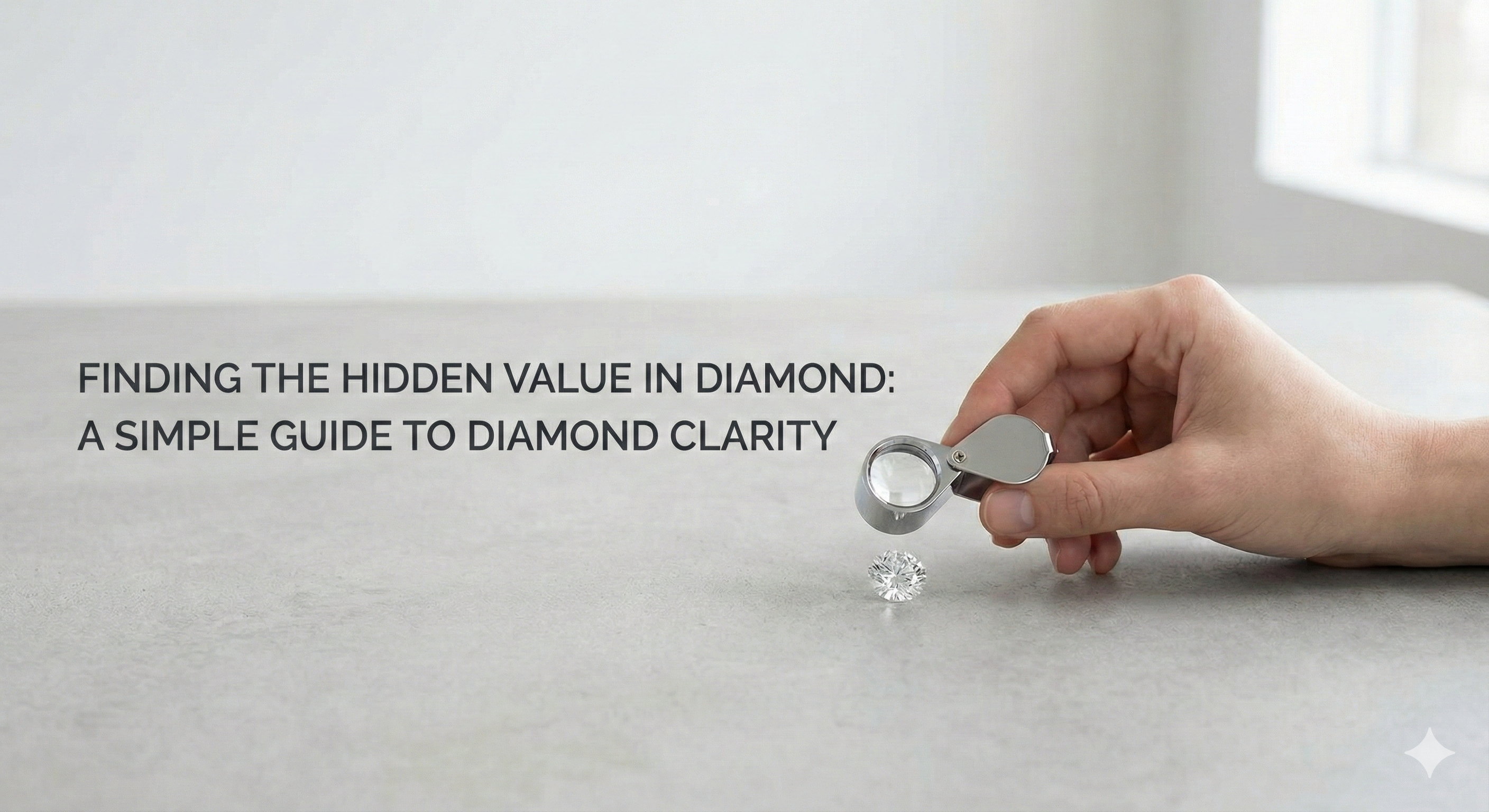
Finding the hidden value in Diamond: A simple guide to Diamond clarity
A diamond’s certificate tells part of its story, but the real magic lies in the details a piece of paper can't capture. When it comes to diamond clarity, the grade is just the beginning. Understanding what clarity truly means helps you find a diamond that offers exceptional beauty and value, without overpaying.
Most buyers think a higher clarity grade automatically guarantees a more beautiful stone. They look at a piece of paper, see "VS1" or "VS2," and assume they are making a safe choice. But the reality of diamond buying is far more nuanced.
At M&B, we believe in total transparency. We don't just sell diamonds; we curate the top 5% of stones that offer true value. To do that, we have to look beyond the grade.
Here is the truth about diamond clarity, why we strictly adhere to GIA standards, and how our 1-10 scale helps us find a masterpiece within a particular category.
The Bottom Line
Don't get lost in the technicalities of the certificate. Remember:
- Stick to GIA standards for a reliable baseline.
- Use the M&B 1-10 Scale to separate technical grade from true beauty.
- Seek hidden value by choosing an eye-clean VS2 or top-tier SI1 over a pricey VS1.
Your perfect diamond is out there. It isn't just about spending more; it's about choosing smarter.
Diamond Clarity and Our Non-Negotiable GIA Standard
Diamond clarity measures the presence of internal characteristics called inclusions and external blemishes. A grade from a laboratory certificate, like the Gemological Institute of America (GIA), tells you how many of these features exist and how visible they are under 10x magnification.
While a higher clarity grade often means a higher price, it doesn't always guarantee a more beautiful diamond.
Before we even discuss clarity further, we must establish the standard. At M&B, we work exclusively with the Gemological Institute of America (GIA).
Why? Because consistency is everything.
Not all laboratories grade diamonds the same way. A diamond graded as an SI1 (Slightly Included 1) by the GIA might easily receive a higher VS2 (Very Slightly Included 2) grade from a different lab, such as HRD.
If you are comparing diamonds across different certificates, you are comparing apples to oranges. We stick to GIA because it is the strictest, most reliable benchmark in the world. When we talk about clarity, we are speaking the language of GIA standards. This ensures that the baseline quality of every stone we offer is undeniable.
Why a certificate is never enough
Relying solely on a GIA certificate can be misleading. A diamond graded VS2 (Very Slightly Included 2) sounds great, but if its inclusion is a noticeable black crystal in the center, it will appear less brilliant. In contrast, an SI1 (Slightly Included 1) diamond with small, white inclusions near the edge can look flawless and sparkle intensely.
This is where expertise comes in. Gemology is a science, and a GIA report is a technical document. It doesn't judge beauty. A "bad" VS2 isn't a mistake by the lab; it's just a diamond that meets the technical grade without offering visual appeal. More than 95% of VS2 diamonds have some degree of visible inclusions, which is why our expert curation is so important.
Gemology vs. Beauty: A Critical Distinction
Gemology is the science of grading a gemstone. It is precise, technical, and objective. However, it does not measure beauty.
A GIA grader does not look at a diamond and ask, "Is this pretty?" They ask, "What is the size, nature, and position of the inclusions?"
This distinction is critical. It is entirely possible for a diamond to receive a respectable VS2 grade while having a black crystal right in the center of the table (the top face of the diamond).
Is the GIA wrong? No. Gemology-wise, the crystal is small enough to technically qualify as a VS2.
Is it a diamond you want to own? Absolutely not.
A black spot in the center of your diamond acts like a mirror. It reflects throughout the stone, killing the sparkle. Yet, on paper, it is a VS2. This is why buying blind off a certificate is a mistake. The certificate tells you the grade, but it doesn't tell you if the stone is lively or dead.
The M&B 1-10 Scale: Finding the hidden value in each diamonds
One of the biggest secrets in the diamond industry is how clarity grades create massive price jumps. While factors like carat weight are fixed, the real price fluctuations—and the hidden value—lie in the interplay between clarity and color.
The price difference between a VS1 and a VS2 can be significant, often around 30%. But what are you actually paying for? A VS1 is "professor league"—so clean that even a professional with a loupe struggles to find inclusions. It’s an amazing quality, but visually, a top-tier VS2 looks identical to the naked eye.
This clarity-color relationship is where you find the biggest shifts in price. Moving from an H color VS2 to a G color VS2 might increase the price by 18%, but the jump from an SI1 to a VVS2 can be even more substantial depending on the color. It's an intertwining relationship.
Here is the hidden value: You don't need to pay the premium for a VS1. You just need to buy a very nice, eye-clean VS2.
The key to finding the best value is selecting a diamond that looks flawless without paying for a flawless grade. This is where the M&B 1-10 scale comes in, simplifying these complex grades into an easy-to-understand quality score that goes beyond what a certificate can show.
By selecting a VS2 that scores a 9 or 10 on our scale, you get a diamond that looks identical to a VS1 for a fraction of the price. You secure the cleanliness, tradability, and rarity without the inflated cost.
However, a word of caution: If you do decide to pay the premium for a VS1, you must ensure it is perfect. Even a VS1 can technically have a black crystal in the center. If you are paying top dollar, make sure you aren't getting a compromised stone.
M&B scale in practice:
- A diamond scoring 1/10 might have a high GIA grade like VS2, but a visible flaw like a black spot under the table will kill its brilliance.
- A diamond scoring 9/10 or 10/10 is where you find true value. It might be graded SI1 or VS2, but it is perfectly "eye-clean," meaning its inclusions are invisible to the naked eye.
The Hidden Value in VS2 and SI1 Diamonds
The secret to maximizing your budget is to find a diamond that looks flawless without paying the premium for a technically flawless grade. This is the art of selecting an eye-clean stone.
An exceptional VS2 diamond offers the same visual perfection as a VS1 but at a significantly lower cost—often up to 30% less. These "super nice" VS2 diamonds deliver a clean appearance and demonstrate a level of quality far beyond their technical grade.
Let's take it a step further. Just as a great VS2 beats a generic VS1 in value, a fantastic SI1 can beat a poor VS2.
The Rapaport list—the industry standard price list that anyone can Google—shows clear price jumps. The jump from an SI1 to a VS2 is steep.
- Scenario A: You buy a "cheap" VS2 that has a black center inclusion. It looks dirty.
- Scenario B: You buy a premium SI1 that is eye-clean, with inclusions hidden on the rim. It looks flawless to the naked eye.
The SI1 in Scenario B is the smarter buy. It costs less and looks better.
This is why we are so particular about the diamonds we select. We filter through thousands of stones to find the very best within each category. By choosing from the top 5%, you are getting a diamond that keeps its value and offers superior beauty.
Tradability and Future Value
Why does this matter beyond the look of the ring? It matters for value retention.
A diamond with a black spot in the center is a diamond nobody wants. If that stone ever goes back to the trade, it will be "punished"—meaning its value will drop significantly because it is hard to resell.
On the other hand, the "super nice" VS2s and premium SI1s are rare. Everyone wants them. They are liquid assets in the trade.
At M&B, we offer a 100% credit for upgrades because we know the quality of our stones. We know that the diamonds we sell are the ones the market desires. It is always nice to know you bought the best item in the category, even if you never intend to sell it.
You Don't Need a Big Budget for a Beautiful Diamond
The diamond world is vast, and there are amazing options available at every price point. You don't have to settle for a "salt and pepper" diamond if you have a smaller budget. You can find a clean, beautiful, and super well-cut diamond that shines brilliantly.
Our focus is on finding these gems for you. By prioritizing eye-clean characteristics and excellent cuts, we ensure you receive a diamond that exceeds expectations, regardless of its official grade.
Our Promise: Clarity You Can See
Choosing a diamond should be an exciting and confident experience. By looking beyond the certificate and focusing on a diamond's true visual performance, we uncover hidden gems that deliver unmatched brilliance. The M&B 1-10 scale simplifies the complexities of clarity, empowering you to understand exactly what you are buying. You don’t need to be a gemologist to find a perfect diamond—you just need an expert eye on our diamonds