How We Choose Our Diamonds: The M&B Selection Process
Snapshot: We reject over 99% of the diamonds we review. Why? Because when you buy GIA certified diamonds in Hong Kong, the certificate is just a starting point, not a guarantee for the quality of the diamond. At M&B, we go beyond the paper grade. Our co-founder, Roi, personally hand-selects every stone using a proprietary 10-point system that evaluates nuances in clarity and color standard reports miss. This ensures you receive a diamond with standout character and exceptional value, backed by our lifetime 100% Credit Upgrade Program.
A Commitment to Quality: The M&B Selection Process
Have you ever wondered why some diamonds outshine others? What makes one diamond stand out even when their certificates look identical? The answer lies in the characteristics of the diamond that go far beyond the standard metrics. The character of a diamond goes far beyond what a standard certificate can tell you.
At M&B Private Jewelers, we believe that choosing a diamond should be an enjoyable experience with peace of mind. This is why we dedicate countless hours to reviewing thousands of diamonds each month, personally selecting only the few that offer exceptional quality and value.
Led by our co-founder, Roi, this hand-selection process is at the heart of our commitment to you. It’s a promise of unwavering quality and accessible excellence. Our goal is simple: find the select few that standout for their characteristics, in color, clarity, and more, ensuring it represents the best in its category. We do not rely on automation or bulk purchasing. Instead, we focus on a rigorous, hands-on process that prioritizes character over basic certification. You deserve a diamond that stands out, not just on paper, but in reality.
In this post, we’ll pull back the curtain on how we identify the diamonds that truly stand out, ensuring you receive a stone that is the best in its class.
Beyond the Certificate: Why a Certificate Isn't Enough
In an industry increasingly reliant on automation and online inventories, our process remains firmly rooted in human expertise. While grading reports from institutions like the GIA provide a crucial baseline, they don’t capture a diamond’s full story. Two diamonds with identical grades on paper can appear vastly different in person. Same carat weight, same color, same clarity. Yet, one is visually stunning while the other is lifeless.
A certificate is a starting point, not the final word. It provides valuable technical specifications, but it cannot convey the stone’s personality, its life, or its visual impact. Relying solely on a certificate is like buying a painting based on a description of the paint colors used, rather than seeing the art itself.
The M&B Standard: Why Hand-Selection Matters
This is where experience makes the difference.
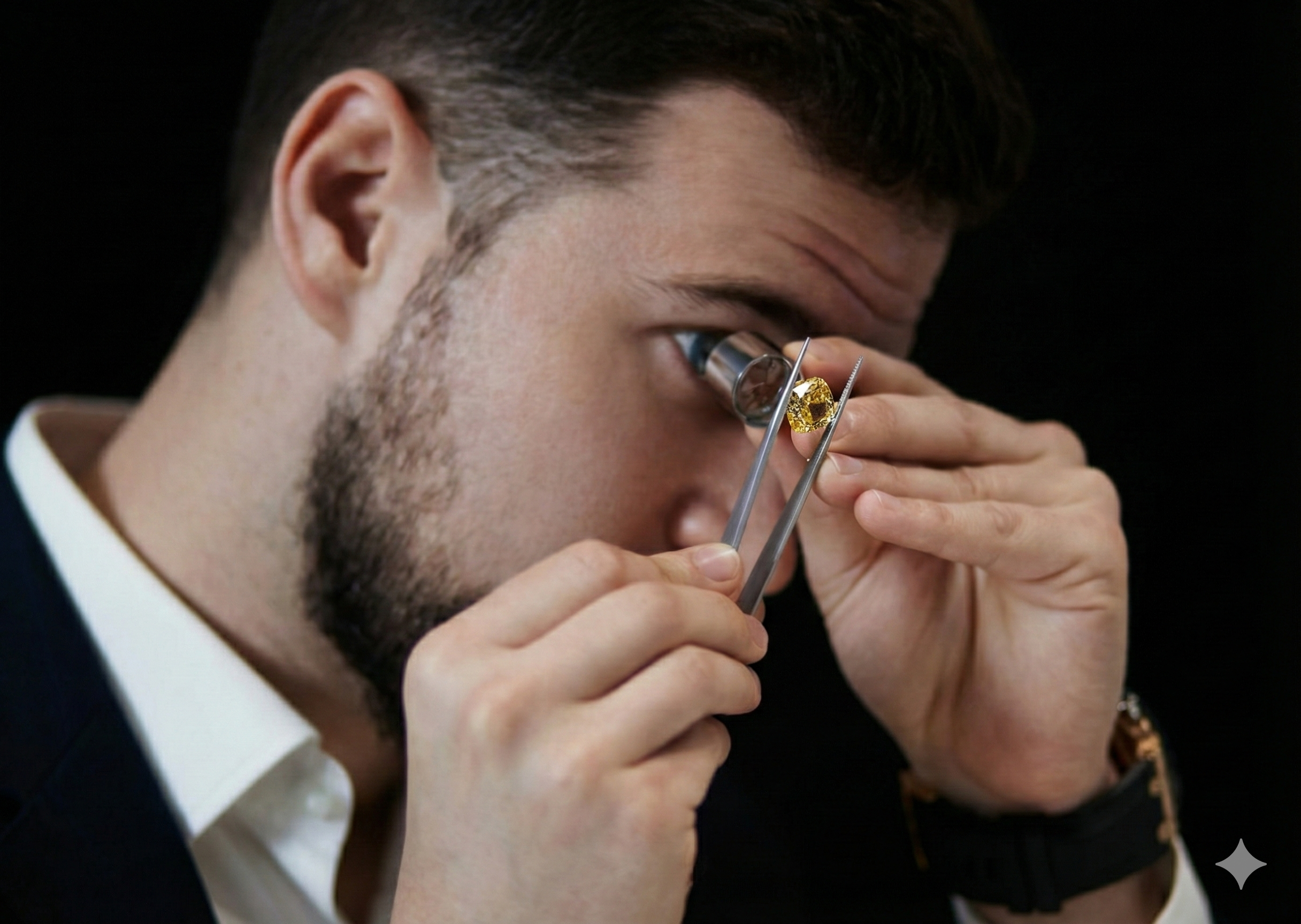
Each month, thousands of diamonds are presented for our consideration. Over 99% are rejected. Roi personally examines each potential diamond for the M&B collection, looking beyond the numbers to assess its true character and visual performance. This isn’t about finding flaws; it’s about discovering character. This meticulous, hands-on standard is our core value. It’s our guarantee that any diamond bearing the M&B name is not just certified, it's chosen.

This hands-on approach allows us to find hidden gems, diamonds that outperform their grade and offer incredible value.
This guide provides an in-depth look into the meticulous process we use at M&B Private Jewelers. We will share why we dedicate hundreds of hours to reviewing thousands of natural diamonds, only to select a small fraction. We will also explain exactly how we come to select those diamonds that standout, from our 1-to-10 grading scale for clarity and color, to how we analyze a diamond’s proportions. This process ensures you receive a diamond that offers superior quality and true value for your investment.
How We Evaluate Each Diamond: A Deeper Analysis into the Four Cs
We assess each diamond against the standard Four Cs (Clarity, Color, Cut and Carat Weight) but with an added layer of scrutiny that sets our collection apart. We look for specific attributes that maximize value and visual appeal.
A Deeper Look at Clarity: Our 10-Point System
A diamond's clarity grade, such as VVS1 or SI2, refers to the presence of internal features (inclusions). However, a GIA certificate does not differentiate between a harmless, invisible inclusion on the edge of the diamond and one that impacts the stone's appearance at its center. This is a crucial distinction that determines a diamond’s real-world quality.
To solve this, we developed our own 10-point scale that we apply within each GIA clarity grade.
- How It Works: We analyze the type, size, location, and color of every inclusion. A small, white feather inclusion hidden near the girdle (the diamond's outer edge) is far superior to a dark carbon crystal located under the main table facet, even if both stones receive an SI1 grade.
- A Practical Example: Imagine two certified 1.5-carat, SI1 clarity diamonds
- Diamond A (M&B Score: 3/10): The SI1 grade is due to a cluster of dark inclusions located centrally. This not only makes the inclusion noticeable under normal viewing conditions but also disrupts the path of light through the diamond.
- Diamond B (M&B Score: 9/10): This diamond’s SI1 grade is from a faint, transparent cloud inclusion situated deep within the stone and off to the side. It is completely invisible to the naked eye and has zero effect on the diamond’s visual performance.
Both diamonds are technically "SI1," but Diamond B is a far superior stone in terms of visual quality and value. Our 10-point scale empowers us to identify and select diamonds like Diamond B. We only choose stones that score an 8 or higher, ensuring you receive a diamond that is the absolute best representation of its clarity grade.

Rating Diamond's Clarity on a 10-point scale provides a precise and insightful way to evaluate diamonds beyond the limitations of standard grading. We can uncover the true character of a diamond within its official grade. For instance, an SI1 diamond scoring 8 or higher on our scale may have inclusions so minor or strategically placed that they are virtually invisible to the naked eye. In contrast, a VS2 diamond with more prominent or centrally located inclusions might score lower on our scale, despite its higher grade.
This means we can identify SI1 diamonds that not only rival but often surpass the visual appeal of some VS2s. For buyers, this translates to greater value: access to diamonds that look cleaner and more refined without the premium price tag of a higher grade. Our system ensures you’re not just buying a grade; you’re investing in a diamond that truly stands out for its clarity and quality.

Color: Finding Value Beyond the Letter Grade
Officially, diamond color is graded on a scale from D (colorless) to Z (light yellow). As with clarity, this single letter grade provides a great base but is often not enough. The cut quality, fluorescence, and undertones (such as brown, green, or grey) can dramatically influence how a diamond's color is perceived once it’s facing up.
As with clarity, we review each diamond on a 10-point color evaluation that assesses the diamond's visual appearance, not just its lab grade.
An Example of Value: Let's compare two 1.2-carat round diamonds.
- F-Color Diamond (M&B Score: 1/10): While technically colorless, this diamond has a slight greyish undertone that dulls its brilliance. The GIA certificate may grade it as F color, but it doesn’t account for the subtle undertones that give the stone a flat, less vibrant appearance.
- G-Color Diamond (M&B Score: 9/10): This diamond demonstrates how cut and overall quality can elevate its appearance. Despite being graded lower on the color scale, its exceptional cut and proportions create a bright, lively sparkle. To the naked eye, it appears more vibrant and brilliant than the F-color diamond, showcasing the importance of evaluating a diamond beyond its certificate.
By identifying the standout among each color grade diamonds, we try to find the stones that provide the visual appeal of a higher grade. This is a core part of our philosophy: securing exceptional value without compromising on visible quality.

Cut: The Science of Light and Proportions of a round brilliant diamond
While clarity and color often get the most attention, a diamond's cut is arguably its most important attribute for a round brilliant diamond. The cut dictates how a diamond interacts with light and is the primary factor behind its visual performance. A GIA certificate provides a cut grade (Excellent, Very Good, etc.), but we scrutinize the specific measurements that produce that grade.
At M&B for Round Brilliant Diamonds we exclusively select diamonds with "Excellent" grades in Cut, Symmetry and Polish. Meanwhile when selecting fancy shape diamonds we would pick "Very Good" as our minimum standard while taking in consideration the depth ratio and proportions
- Symmetry and Polish: Excellent symmetry ensures every facet is perfectly aligned to reflect light evenly. Excellent polish guarantees a perfectly smooth, unblemished surface for a clear, crisp finish.
- Depth Ratio and Proportions: The relationship between a diamond's depth, table size, and overall diameter is critical. We operate within a very narrow "sweet spot" of ideal proportions.
- Too Shallow (Depth < 60%): A shallow cut causes light to leak out of the bottom, creating a dull, glassy area in the center known as a "fisheye."
- Too Deep (Depth > 62.8%): A deep cut allows light to escape through the sides, resulting in a dark, lifeless appearance. These diamonds also tend to look smaller than their carat weight suggests.
Our selection process filters out diamonds that fall outside these ideal parameters. This ensures that every M&B diamond is proportioned to maximize its interaction with light, giving it a lively and impressive character.
A diamond’s table should never exceed its depth. The ideal table size falls between 56% and 59.5% of the diamond’s depth, a range that ensures optimal light performance. When the table is too large, it disrupts the balance of light reflection, diminishing the diamond’s brilliance. By adhering to this precise proportion, we guarantee that every diamond in our collection achieves its maximum sparkle and fire.
Each diamond shape, such as pear, radiant, or marquise, has its own unique characteristics that require a specialized evaluation. At M&B, we’ve developed tailored systems for reviewing each cut, ensuring that every diamond is assessed based on what makes it exceptional. This meticulous approach allows us to highlight the beauty and brilliance of each shape, offering our customers diamonds that truly stand out.

Carat: Balancing Weight, Dimensions, and Value
Carat is a simple unit of weight, not a measure of visual size. A poorly cut 2-carat diamond can have a smaller face-up diameter than a masterfully cut 1.80-carat diamond. Our philosophy is to find the perfect equilibrium between quality and scale.
We focus on diamonds with excellent proportions that maximize their visual size for their weight. This ensures you invest in a stone that presents its size impressively, rather than just paying for weight that is hidden in its depth. We often find exceptional value in diamonds just under popular weight thresholds (e.g., a 1.70ct-1.80ct instead of a 2.0ct). These stones can offer significant savings without any visible difference in size to the naked eye.
A Commitment for Life: The 100% Credit Upgrade Program
Our relationship with you does not end at the point of sale. We believe the value of your diamond should be protected for life. That is why every natural diamond selected through our rigorous process is eligible for our 100% Credit Upgrade Program.
This program is our promise of an enduring partnership and stands for the quality of each and every diamond that come through the M&B doors. At any time in the future, you can apply the full original purchase price of your M&B diamond toward a new one of greater value. There are no hidden fees or deductions. As your life unfolds and you celebrate new milestones, your investment can evolve with you. This ensures your M&B diamond is not just a beautiful object, but a store of value with lasting worth.
The M&B Promise as a Diamond Store in Hong Kong and Singapore
Our process is intensive, meticulous, and uncompromising. It is designed to remove uncertainty from one of life’s most important purchases. It is our promise that any diamond in our collection is a leader in its class for quality, character, and value. We do the exhaustive work so that you can make your choice with absolute confidence.
Explore our hand-selected diamond collection or book a private consultation to experience the M&B difference.
Frequently Asked Questions
1. If two diamonds have the same GIA grade, why does M&B choose one over the other?
The GIA report is a technical map, not a portrait of the diamond's beauty. The location, color, and type of an inclusion can make one SI1-grade diamond appear flawed while another looks perfectly clean. Our expert visual inspection allows us to identify the superior stone that the certificate alone cannot.
2. How does the 10-point scale benefit me as a buyer?
It provides a higher level of quality assurance. Instead of simply getting a "G color" diamond, you get a G color diamond that our experts have verified as a top-tier visual example of that grade. This maximizes the beauty and value of your stone within your budget.
3. Does this intensive selection process make M&B diamonds more expensive?
No. Our process is about finding the best value. By identifying an F-color diamond that looks like an E, or an SI1 that appears eye-clean, we secure stones with superior visual qualities at a more accessible price point than a technically higher-graded (but visually similar) diamond.
4. How does the 100% Credit Upgrade Program work?
When you decide to upgrade, you can trade in your M&B natural diamond. You will receive a credit for 100% of its original purchase price to use toward any new diamond of greater value. There is no time limit. It's a simple, transparent way to ensure your jewelry grows with you.