A guide to identifying and avoiding the bow-tie shadow
A diamond's cut is arguably its most important characteristic, responsible for the fire, brilliance, and scintillation. These qualities make the stone come alive. For fancy shapes like oval, marquise, and pear, the cutter’s skill is put to the ultimate test. One of the most common challenges in these elongated cuts is an optical effect known as the "bow-tie" shadow. This guide offers an expert look into what this phenomenon is and how to select a stone. It explains how to minimize its impact, ensuring your diamond performs with maximum brilliance.
Understanding the nuances of fancy cuts empowers you to make a more informed and confident investment. The bow-tie is not a flaw in the traditional sense, but an inevitable consequence of a diamond's facet structure. However, its prominence can vary dramatically, and knowing what to look for is critical to choosing a truly exceptional stone.
What is the bow-tie shadow?
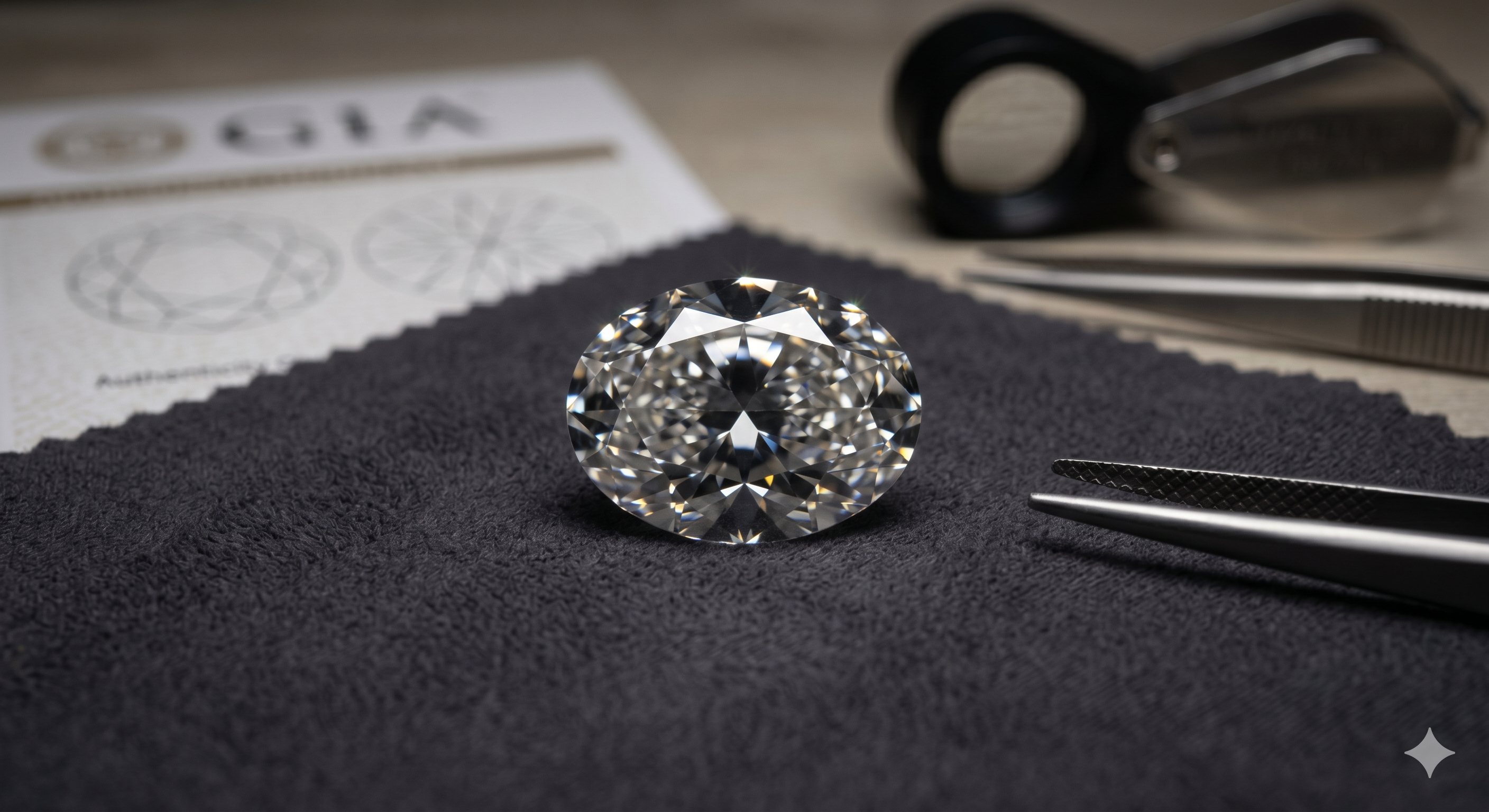
The bow-tie is a dark, bow-tie-shaped shadow that can appear across the center of certain fancy-cut diamonds. This effect is most prevalent in elongated shapes, including oval, marquise, and pear cuts. It is not a reflection from the observer's head or an inclusion within the stone. Instead, it is an area where light entering the diamond is not properly reflected back to the eye. This creates a dark contrast against the brighter facets.
It's important to understand that nearly every oval, marquise, and pear-shaped diamond will exhibit a bow-tie to some degree. Its presence is a natural result of the faceting pattern required to create these elegant shapes. The goal is not to find a diamond with no bow-tie at all, which is nearly impossible. Instead, select one where the effect is subtle and does not detract from the stone's overall beauty.
Why does the bow-tie effect occur?
The bow-tie shadow is a direct result of light leakage. A diamond's brilliance comes from light entering through the top (the table), bouncing off the bottom facets (the pavilion). That light then returns to the viewer's eye. In elongated shapes, the pavilion facets are cut at varying angles. The facets along the long ends of the stone are different from those in the wider "belly" section.
This variation in facet angles means that some light entering the diamond from certain angles will not be successfully returned. Instead, it "leaks" out of the bottom of the stone. The bow-tie is the visible result of this light leakage, creating a shadow in the areas where light is lost. The skill of the diamond cutter is paramount in minimizing this effect. They do this by carefully planning the angles and alignment of the pavilion facets. This planning helps maximize light return across the entire stone.
How to identify the bow-tie
Identifying a bow-tie requires careful, in-person observation. This is one reason why diamond grading reports, while essential, cannot tell the full story. A GIA certificate will not mention the presence or severity of a bow-tie. You must view the diamond yourself, preferably in various lighting conditions.
When examining a stone, hold it at a comfortable viewing distance and gently rock it back and forth. Observe how the light plays across its facets. The bow-tie will be most noticeable as you look directly down at the center of the diamond. A pronounced bow-tie will appear as a dark, static shape that remains visible from most viewing angles. In a well-cut diamond, the dark area may appear to flash or diminish as you tilt the stone. It should blend in with the surrounding sparkle. A severe bow-tie, however, will look like a dark, lifeless "dead spot" right in the heart of the diamond.
Avoiding a dominant bow-tie
While you cannot completely eliminate the bow-tie, you can select a diamond where it is less prominent. The key is to find a balance where the dark contrast enhances the diamond’s character. It should never overpower the stone's brilliance.
Prioritize the cut quality
The most critical factor is the quality of the cut. An expert cutter can minimize the bow-tie by precisely arranging the facets to optimize light performance. They manipulate the pavilion depth and facet angles to reduce the size of the light-leakage window. While specific depth percentages and table sizes can offer clues, there is no magic formula. Two diamonds with identical proportions on paper can have vastly different visual appearances. This is where the artistry of the cutter makes all the difference.
View the diamond in person
There is no substitute for seeing the diamond with your own eyes. Photographs and videos can be misleading, as lighting and angles can be manipulated to hide or exaggerate a bow-tie. When you assess a stone in person, you can see how it performs in real-world conditions. Move it under different light sources, from direct spotlights to softer, ambient light, to see how the shadow behaves. A desirable stone will have a bow-tie that is not distracting and is balanced by the vibrant sparkle around it.
Look for lively brilliance
A well-cut oval, marquise, or pear shape should exhibit a brilliant, even pattern of light and dark flashes. This pattern is often called "scintillation." This dynamic interplay is what gives a diamond its life. In a superior stone, the bow-tie area will still show some sparkle. It will not look flat or dull. If the bow-tie appears as a stark, black void that dominates the diamond’s face, it is best to avoid it. The goal is to find a diamond where the overall brilliance is so captivating. The subtle bow-tie should become an integrated part of its unique character.